An
 Initiative
Initiative
Initiative
The Environmental Farm Plan (EFP) is an opportunity to assess areas of strength and potential environmental risks on a farming operation. It provides a farm with increased awareness of areas of potential environmental concern and helps outline site-specific, individualized plans to address, monitor or compensate these risks. It is voluntary and free, and it considers the farming operation as a whole. The EFP program offers all of this in an easy to use, flexible, online format. The EFP began in 2003 and has been delivered by the Agricultural Research and Extension Council of Alberta (ARECA) since 2013.
ARECA is a non-profit farmer/rancher led organization supporting a network of research and extension associations to connect producers to programs, services, innovations, and research to improve the profitability and sustainability of their farm business. Funding for the EFP is provided by the governments of Canada and Alberta under the Sustainable Canadian Agricultural Partnership.
Alberta EFP is responsible for the Environmental Farm Plan (EFP) program across the province. We work with Alberta producers and the industry groups that represent them to create awareness of the designation and its benefits, and to encourage producers to complete an EFP workbook.
Our work includes:
Alberta EFP is preparing for a future where the majority of commodities are sustainably sourced. Consumers and the agri-food industry are demanding proof that agricultural products are safe and healthy, and grown with minimal impact on the environment. We will achieve that by working with industry, sustainable sourcing initiatives, and other EFP programs to create national standards, reduce overlap and to streamline the EFP as much possible, while retaining its integrity.
Alberta EFP strives to develop and deliver an EFP program that meets or surpasses international standards. Our goal is to help Alberta agricultural producers demonstrate their commitment to environmental stewardship by completing an EFP. We will achieve this by sharing information, collaborating with industry, and providing services of the highest quality and consistency delivered by committed and trained technicians.
The Environmental Farm Plan (EFP) program in Alberta was established in the early 2000s by the Government of Alberta in partnership with agricultural producer groups as a voluntary, producer-led initiative to identify and manage environmental risks on agricultural operations. It was developed with support from the Ontario Farm Environmental Coalition, the Ontario Soil and Crop Improvement Association, and the Ontario Ministry of Agriculture, Food and Rural Affairs, and was adapted from the Ontario EFP Workbook. The original EFP concept originated from Wisconsin’s Farm A Syst program.
During its first six years, program delivery was contracted to the Environmental Farm Plan Company. In 2009, responsibility for the program returned to the Government of Alberta. Since 2013, the Agricultural Research and Extension Council of Alberta (ARECA) has administered and delivered the program on behalf of the province, ensuring its continued relevance to modern agriculture, regulatory expectations, and sustainability initiatives.
The EFP has become widely integrated across agricultural sectors and programs. In 2014, the Potato Growers of Alberta became the first agricultural organization to require an EFP as a condition of membership. Collaborative adaptations, such as the Poultry Environmental Evaluation Program (PEEP) were later developed with the Egg Producers of Alberta. In 2021, Dairy Farmers of Canada mandated EFP completion under the environmental module of the proAction® program. EFP completion is also required or recognized for participation in programs including AgriInvest, Sustainable Canadian Agricultural Partnership (Sustainable CAP) funding, select ALUS initiatives, and is recommended under programs such as Verified Beef+.
To support market access and sustainability verification, Alberta EFP introduced EFP+, an enhanced assessment aligned with the internationally recognized framework, the Sustainable Agricultural Initiative Platform’s Farm Sustainability Assessment (FSA). Organizations including Rahr Malting and the Alberta Sugar Beet Growers have adopted EFP+ to demonstrate verified sustainability outcomes.
The EFP program is also embedded in agricultural education across the province. Lakeland College, Olds College of Agriculture & Technology, and Lethbridge Polytechnic actively support the use of the EFP and include EFP training within their agricultural programs, reinforcing environmental stewardship among future producers.
As of 2025, approximately 33% of Alberta’s agricultural land is covered by an approved EFP, underscoring the program’s broad adoption and its role as a cornerstone of environmental risk management, sustainability assurance, and market readiness for Alberta agriculture.
All EFP program staff are registered members of the Alberta Institute of Agrology and are designated as a Professional Agrologist (P. Ag.) or as a Registered Technologist in Agrology (RT. Ag.).

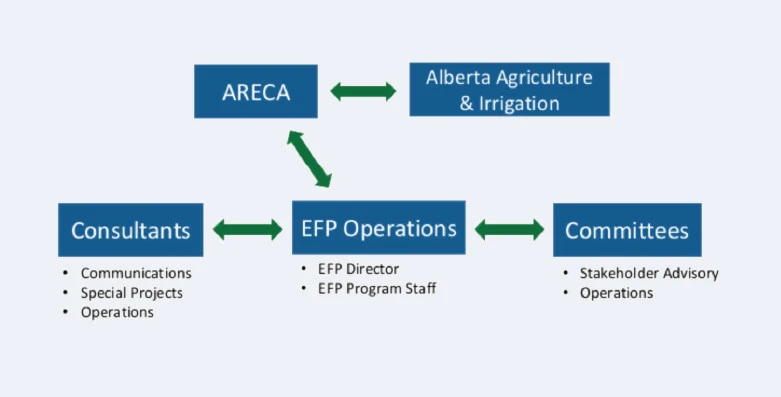
EFP Operations Manager,
P. Ag
Program Manager,
P. Ag.

EFP Special Projects,
P. Ag.

EFP Director,
P. Ag.
It is important to protect our land and the environment to maintain profitability and for future generations. It was valuable to [reinforce] what I have been doing is correct and positive.
Gordon Ellis, Crop farmer, Mountain View County
I am concerned about my affect on the environment, so this is a good tool to understand [my impacts]. The workshop was helpful in navigating the EFP. The technicians were helpful and friendly.
Wayne Groot, Potato farmer, Sturgeon County